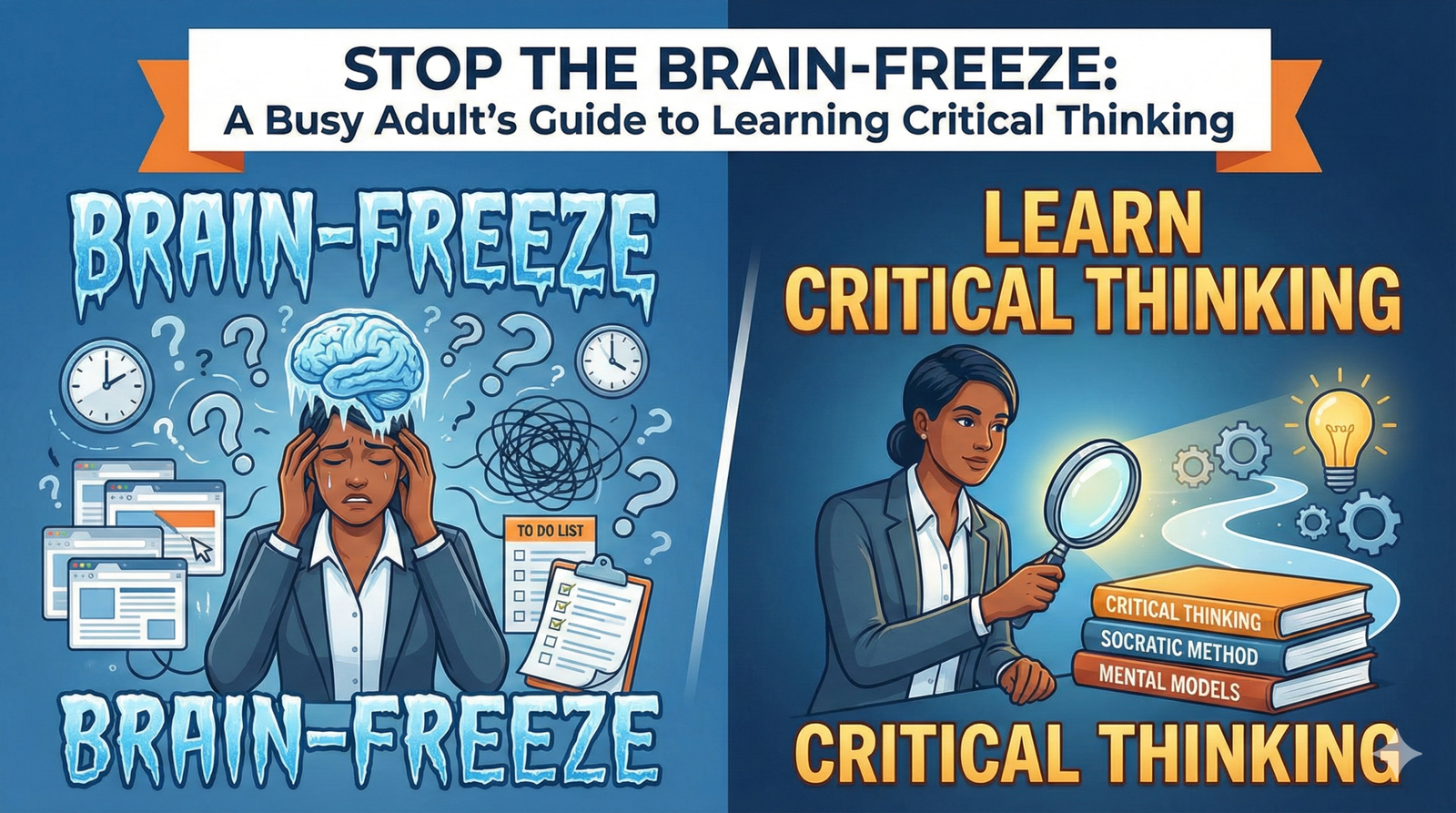
Ever found yourself standing in the middle of a grocery store aisle, staring at sixteen different brands of olive oil as if the fate of the free world depended on whether you chose “cold-pressed” or “extra virgin”? Your brain starts doing that thing where it tries to calculate the price per ounce while simultaneously worrying about the environmental impact of the plastic bottle and wondering if your dinner guests will secretly judge your taste in monounsaturated fats. This, my friend, is the “spinning wheel of death” for the human brain, otherwise known as overthinking. It feels like your internal GPS is stuck on “recalculating” while you’re just trying to get home. We’ve all been there, paralyzed by a mountain of “what-ifs” that make making even the simplest decision feel like trying to solve a Rubik’s Cube in the dark.
The irony is that we often think overthinking is the same thing as being careful or smart, but it’s actually the opposite of a very powerful tool called critical thinking. If overthinking is like a cluttered attic full of dusty boxes you’re afraid to open, critical thinking is like a high-end water filter for your brain. It takes all that murky, confusing “tap water” of information and filters out the sediment, the biases, and the junk, leaving you with a glass of clear, refreshing clarity. It’s not about thinking more, it’s about taking charge of the structures of your thought and imposing some much-needed quality control on them.+2
This isn’t some new-age trend designed to sell overpriced planners, either. It actually goes back to a guy named Socrates, an ancient Greek who basically made a career out of being the world’s most annoying (but brilliant) “why” guy. He believed that the unexamined life wasn’t worth living and that the best way to find the truth was to keep digging beneath the surface of what we think we know. Today, we call this the Paul-Elder framework, which is just a fancy way of saying there’s a system for checking if your thoughts are actually based on facts, logic, and fairness rather than just a gut feeling or something you saw on a TikTok at 2:00 AM.+3
In the world of 2026, we’re living through what some researchers call the “AI-Critical Thinking Paradox”. We have AI tools that can generate answers in seconds, which sounds like a dream for an overthinker, right? Except, it actually makes the stakes higher. If we just passively accept what a computer tells us, we risk losing the very cognitive muscles that make us smart in the first place. Research warns that over-relying on AI can lead to “cognitive standardization,” where we all start thinking and talking in the same homogenized way. Critical thinking is the “human operating system” that ensures we stay in the driver’s seat, using technology as a partner rather than a replacement for our own brains.+2
Think of it like this: if you’ve ever had a laptop that starts to run slow because you have fifty tabs open, critical thinking is the “Force Quit” button. It helps you identify which “tabs” in your head are actually useful and which ones are just sucking up your battery life. Famous leaders throughout history have used this “OS” to do the impossible. Aristotle used it to categorize the entire natural world. Steve Jobs used it to simplify complex tech into something a toddler could use. Even Albert Einstein famously said that the most important thing is to never stop questioning, because curiosity is its own reason for existing. They weren’t smarter because they thought faster; they were smarter because they knew which questions to ask.+4
If you’re ready to stop the mental paralysis and learn critical thinking, the first step is actually surprisingly simple: you have to get comfortable with saying, “I don’t know.” In a world that expects us to have an opinion on everything from global economics to the best way to fold a fitted sheet, admitting you don’t have all the facts is the ultimate power move. It’s what experts call “intellectual humility,” and it’s the foundation of everything else. Once you stop pretending you have to be right all the time, you can start focusing on being less wrong.
To help you get started on this journey, I’ve put together five simple “brain gym” exercises that you can try right now. These aren’t like high school algebra; they’re actually designed to be used in the real world when you feel that overthinking start to creep in.
First, try the “5 Whys” analysis. Next time you’re stuck on a decision, ask yourself “why” you feel that way. Then ask “why” to that answer, and repeat it five times. Usually, by the third or fourth “why,” you’ve moved past the surface-level anxiety and found the root cause of what’s actually bothering you. It’s like being a detective in your own head.+1
Second, give “Reverse Brainstorming” or “Inversion” a shot. Instead of asking, “How do I make this project a success?”—which is a huge, paralyzing question—ask, “What are all the ways I could absolutely guarantee this project fails?” Once you list those out, you just have to avoid them. It sounds silly, but our brains are often much better at spotting disasters than envisioning perfection.+1
Third, practice the “Fact vs. Opinion” drill. Pick a news headline or a spicy social media post and ask: is this a provable fact, or is it just someone’s very loud opinion? If it’s a fact, where is the evidence? If it’s an opinion, what is the person’s bias?. This is like having a bouncer for your brain who only lets the “VIP” (Verified Important Proof) information inside.+1
Fourth, try “Perspective Taking”. If you’re in an argument or stuck on a work problem, force yourself to write down the strongest possible argument for the opposite of what you believe. This is called “Steelmaning,” and it’s the antidote to that narrow-mindedness that often leads to overthinking.+1
Finally, do a “Pre-Mortem”. Before you commit to a big move, imagine it’s a year from now and the decision was a total disaster. Now, work backward and figure out exactly what went wrong. This helps you spot “red flags” before they happen, giving you the confidence to move forward because you’ve already prepared for the worst-case scenario.+1
If you want to go even deeper, there are some incredible books out there that feel less like school and more like a conversation with a brilliant mentor. My “Top 5” list for your shelf would be:
- Thinking, Fast and Slow by Daniel Kahneman — This is the “Bible” of understanding why our brains take shortcuts and how to avoid them.+2
- Super Thinking by Gabriel Weinberg & Lauren McCann — A fantastic collection of “mental models” that you can apply to almost any problem.+2
- The Miniature Guide to Critical Thinking by Richard Paul & Linda Elder — A tiny but mighty book that breaks down the whole framework into bite-sized pieces.+2
- The Demon-Haunted World by Carl Sagan — A beautiful defense of scientific thinking and how to stay skeptical in a world full of nonsense.+2
- Algorithms to Live By by Brian Christian & Tom Griffiths — This one is fascinating because it shows how computer science logic can actually help humans make better everyday decisions.+1
Imagine what your life would look like if you could make a decision and then actually relax afterward. No more lying awake at 3:00 AM wondering if you should have said that one thing in that one meeting three years ago. Critical thinking doesn’t just make you smarter; it makes you freer. It gives you the permission to move forward, knowing that you’ve done the work, checked the facts, and made the best choice possible with the information you had.
So, have you ever felt that “overthinking freeze” lately? I’m going on this journey to better thinking too, and I’d love to hear what’s been helping you clear the mental fog. Drop a comment below or tag me on social media to let me know which of these exercises you’re going to try first!
If you found this helpful and want more tips on how to master the tech and tools of modern life without losing your mind, come join the conversation. You can share your breakthroughs and tag @iamcezarmoreno on social media, or even better, join the community over at https://cezarmoreno.com for more insights, deep dives, and the occasional tech-related joke. Let’s stop overthinking and start living!