Picture yourself mid-morning, a problem sitting in front of you. It’s not a hard problem, necessarily. Maybe it’s a memo that needs writing, a decision that needs thinking through, an email that could use some care. You’ve been doing this kind of thing for years. You know how to do this. And yet, before your brain has had thirty seconds to warm up, before you’ve given the question even a fighting chance to breathe, your fingers are already moving. Not to type your thoughts. To ask AI to think for you.
Nobody decided to stop thinking. That’s what makes this so strange. It’s happening quietly, one small surrender at a time, dressed up as efficiency and called progress. And if you’re not paying attention, you might not notice until the muscle is already soft.
Here’s the question that actually matters: in a world where AI can do the thinking, are you still doing it? Not just at work. In life. When you wake up in the morning and need to solve something, is the first move still yours? Or have you been quietly outsourcing the most important thing you own?
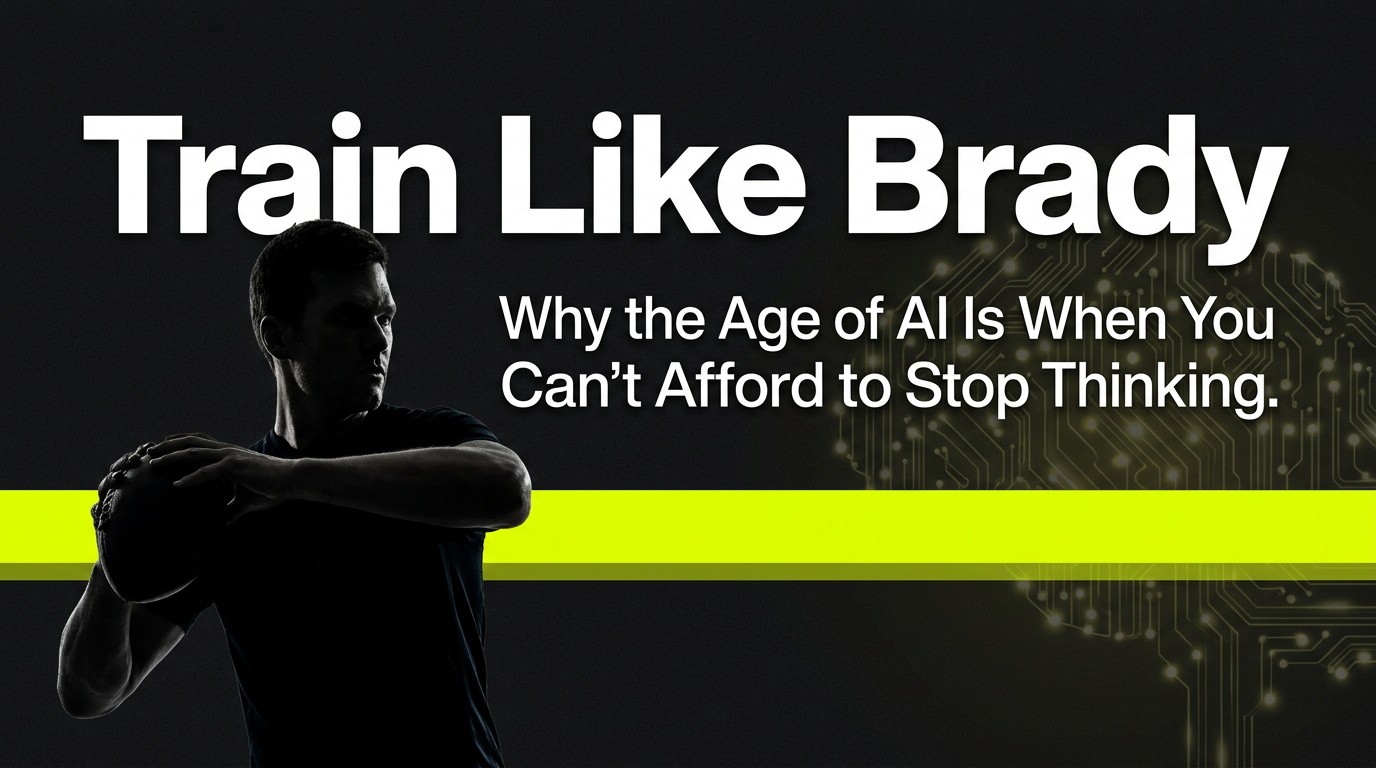
Tom Brady retired as arguably the greatest quarterback of all time. Seven Super Bowl rings. Twenty-three seasons. A body that was pushing 45 years old competing against guys who hadn’t yet started paying their own rent. People always asked the same question about him: how? How do you stay that sharp that long? And the answer was never talent. Talent was the starting point, not the destination. The answer was obsessive preparation. Film study at hours when most of his teammates were asleep. A diet and recovery regimen so disciplined it bordered on religious. A refusal, even at the peak of greatness, to coast. Brady was the best quarterback in the league and still the hardest worker in the building. That’s not a coincidence. That’s the formula.
Your brain works the same way. Use it relentlessly and it compounds. Let it rest and it atrophies. The only difference between Brady and everyone else isn’t the raw material. It’s the commitment to keep showing up to practice even when you’re already good, even when it would be so easy to let the machine do it for you.
The machine is getting really good, by the way. That part isn’t debatable.
But here’s what nobody’s really talking about in all the hype around AI: the more powerful the tool, the more dangerous the temptation to stop working. And the people who are going to matter most in the next decade aren’t the ones who avoided AI. They’re the ones who used it and still showed up to practice.
Let’s talk about what’s actually happening inside your skull when you lean too hard on AI. Because it’s not nothing. A four-month study out of MIT’s Media Lab monitored brain activity via EEG while participants wrote essays, some without assistance, some with internet search, and some with ChatGPT. The results don’t leave a lot of room for optimism about passive use. Participants who used ChatGPT wrote sixty percent faster. Sounds great. But their relevant cognitive load, meaning the actual intellectual effort required to transform information into knowledge, dropped by thirty-two percent. Brain connectivity was nearly halved, measured through alpha and theta wave activity. And eighty-three percent of the AI users couldn’t remember a passage they had just written. They produced work. They just didn’t own it. The output existed. The thinking didn’t.
That’s not a warning about some future risk. That’s what’s happening right now on an ordinary Tuesday in your office.
There’s a term for this: cognitive offloading. The practice of using external tools to carry mental tasks you’d otherwise handle internally. Human beings have always done some version of this, writing things down, using calculators, keeping notes. The problem isn’t offloading in itself. The problem is when you offload the things that, if you’d actually done them yourself, would have made you smarter, sharper, and more capable over time. When the offloaded task is the workout, not just the warm-up, that’s when atrophy sets in.
The prefrontal cortex is where your highest-order thinking lives: planning, reasoning, judgment, creativity. Every time you hand those tasks to AI before attempting them yourself, that region gets a little less exercise. Researchers studying heavy AI use are watching a pattern emerge: the more we automate our thinking, the less we trust and exercise our own cognitive abilities. A Microsoft study involving 319 knowledge workers found a significant negative correlation between the frequency of AI tool use and critical thinking scores, r equals negative 0.49 for those keeping score. The more often people used AI, the less critically they thought. Not because the tools made them incapable. Because they stopped trying.
None of this is new, actually. We’ve watched this exact pattern play out before, and we called it progress at the time.
GPS killed our sense of direction and we barely noticed. A landmark study out of McGill University followed fifty regular drivers over three years and found something striking: people with greater lifetime GPS experience used hippocampus-dependent spatial memory strategies significantly less when navigating without assistance. And the longitudinal piece is the part that should really catch your attention. Greater GPS use since initial testing was directly associated with a steeper, dose-dependent decline in spatial memory over time. Critically, it wasn’t that people with a bad sense of direction used GPS more. The opposite was true. Using GPS led to the decline in spatial memory, not the other way around.
The hippocampus built maps of your world because it had to. When GPS took over that job, the brain stopped building maps. Not dramatically. Gradually. Quietly. Route by route, year by year, until one day you genuinely couldn’t find your way around a neighborhood you’d visited a dozen times without your phone. The brain outsourced navigation and then forgot how to navigate.
Now AI is doing the same thing, but instead of spatial memory, it’s going after reasoning, language, writing, judgment, and creativity. The mechanisms are identical. The stakes are considerably higher.
Here’s a distinction worth spending some time on: the difference between a tool and a crutch. A hammer doesn’t swing itself. You bring the knowledge, the skill, the judgment about what needs to be built and how. The hammer amplifies your capability. It doesn’t replace it. That’s a tool. A crutch, on the other hand, doesn’t amplify anything. It compensates for something you can no longer do on your own, and the longer you use it, the less able you are to walk without it.
AI can be either of these things. That’s what people miss when they argue about whether AI is good or bad. The tool itself isn’t the issue. How you hold it is. Harvard’s own faculty have made this point directly: if you let AI write your first draft, if you go to it before you’ve wrestled with the problem yourself, you are letting it do your thinking, not assist your thinking. And there’s a subtle trap in that: the output still looks like yours. It’s convincing. It might even be good. But you didn’t earn it, and your brain didn’t grow from producing it.
There’s a concept that captures this perfectly, and it should make you a little uncomfortable: the illusion of competence. When AI produces output that you then review and approve, the brain registers it as understanding. You feel like you understood the material because you read it and it made sense. But comprehension is not the same as construction. You can recognize a correct answer without being able to generate one. And if you never practice generating, recognition is all you’ll ever have. The next time you need to actually think something through, without the AI in the room, the gap shows.
Think about that the next time you’re in a meeting and someone asks you to go off-script.
Now look at what’s happening on a broader scale, because the individual effects are just the first layer. Replace sustained reading with passive scrolling and something starts breaking down at the neurological level. Research published in 2024 and reinforced by longitudinal OECD PISA data shows measurable declines in reading comprehension, reasoning, and problem-solving skills among adults in most developed countries, with the steepest drops coinciding precisely with the widespread adoption of smartphones and on-demand video. Maryanne Wolf’s work on what she calls deep reading, the kind your brain does when you sit with a long text and build mental representations of it, argues that the neural circuits for analytical reading are weakening in real time, replaced by circuitry optimized for speed and superficial processing.
Reading does something that screens fundamentally don’t: it demands that your brain construct the world being described. Visual media hands you the construction pre-made. Television, social feeds, short-form video, they all interpret reality for you before you’ve had the chance to interpret it yourself. The cognitive load is minimal. The engagement is passive. And the part of your brain that was supposed to be getting a workout is just sitting there, watching.
Meanwhile, teens are spending upward of seven hours a day on screens outside of schoolwork, and that’s not a trend that stops the moment they enter the workforce. The adults who are using AI tools most heavily today grew up in a culture that was already optimizing for consumption over creation, for speed over depth. The AI isn’t creating the problem. It’s accelerating something that’s been in motion for a decade.
Here’s where it gets personal, though, because statistics don’t actually change behavior. Stories do.
You’re learning a language right now. A real one. With grammar rules that don’t play nice with English, vocabulary that takes genuine repetition to stick, a speaking component that requires your brain to retrieve and construct in real time under mild social pressure. That’s not a hobby. That’s a cognitive training regimen. The research on language learning and neuroplasticity is robust, and it consistently points the same direction: learning genuinely difficult things, things that resist shortcuts, builds the kind of mental flexibility that transfers across every domain.
You’re playing golf. Pool. You’re putting real hours into physical skills that require focused attention, proprioceptive feedback, and the kind of deliberate practice that can’t be faked or fast-tracked. No AI can swing the club for you. No AI can read the table. Your brain has to actually learn these things the hard way, one rep at a time, through failure and adjustment and more failure. Every single hour you spend on that practice is the equivalent of Brady throwing routes in the offseason. Nobody’s watching. Nobody’s grading it. But the neural pathways are being built, and they’ll be there when you need them.
That’s the thing about Brady that most people don’t fully appreciate. He didn’t train like that because he was worried about losing his job. He trained like that because he understood, at some fundamental level, that the moment you stop investing in the machine, the machine starts declining. It doesn’t plateau. It declines. The discipline wasn’t about fear. It was about identity. This is who I am. I’m the guy who puts the work in.
The people who’ll thrive in the next decade are going to be defined the same way, not by whether they use AI, because everyone will, but by whether they stayed in the gym.
What does that actually look like in daily life? Not as a philosophy, but as practice. Because the gap between knowing this and doing something about it is where most people get stuck.
It starts with writing your own first draft before you ask AI to improve anything. Not because the draft will necessarily be better. It might be rougher. But the act of wrestling with the ideas, of finding the words yourself, of sitting with the discomfort of not quite knowing what you mean yet, that’s the workout. The struggle is the point. Once you’ve done that work, then use AI to sharpen it. Now you’re a craftsperson with a power tool, not someone who asked the tool to build the furniture and called it theirs.
Same principle applies to problem-solving. Give the problem twenty minutes of your own thinking before you give it to AI. Write your perspective down. What do you actually believe? What are you uncertain about? Where are the real decision points? Then use AI to pressure test it, to find the holes, to surface angles you missed. That’s the owl on your shoulder, in the words of one Harvard researcher. Not the other way around.
Read long-form, consistently. Not LinkedIn posts. Not newsletters that summarize other newsletters. Books. Long articles that require you to hold a thread across multiple pages and integrate it with what came before. Maryanne Wolf’s point about deep reading neural circuits isn’t abstract. You are either building those pathways or you’re letting them thin. Twenty pages a day isn’t a life philosophy. It’s maintenance.
Navigate without GPS occasionally. Not as a stunt, but as a reminder that your brain can actually do this if you give it the chance. Take a drive somewhere familiar with the phone face down. Walk a route and pay attention. Let the hippocampus do what it was built to do. The McGill researchers were clear: the decline they documented wasn’t inevitable. It was a function of use. Or the lack of it.
Learn something genuinely hard on purpose. A language, a physical skill, a domain that doesn’t overlap with your professional expertise. The specifics matter less than the difficulty. Your brain needs to encounter things it can’t immediately solve and stay in the discomfort long enough to adapt. That adaptation is neuroplasticity. It doesn’t care what domain you’re in. What it cares about is whether you showed up and did the reps.
The question at the center of all of this isn’t really about AI. AI is just the current version of a question humans have been wrestling with since we invented writing: does this tool make me more capable, or does it make me more dependent? Both are possible. The outcome depends entirely on how deliberately you engage with it.
You can use GPS and still practice navigation. You can use AI and still practice thinking. But you have to actually practice. That’s the part that requires intention, because nothing about the design of these tools is going to nudge you toward the harder path. Convenience, by definition, is frictionless. And friction is where the growth lives.
Brady understood that the easy path was always available and almost always wrong. The work wasn’t a burden. It was the thing. The preparation was the point, not just a means to the performance. The performance was just evidence that the preparation worked.
So the real question isn’t whether AI is thinking for you. The question is whether you’ve decided that your mind is worth training. Whether you’re the kind of person who shows up to the film room even when you’re already the best player on the field. Whether you treat your cognitive capacity like the perishable, improvable, extraordinary thing that it actually is.
Because here’s what the research and the neuroscience and a twenty-three-year NFL career are all pointing toward: capability is not a fixed thing you either have or you don’t. It is a practice. And the people who keep practicing, in the age of AI, are going to be in a category by themselves.
The machine is a tool. You’re the player. Get in the gym.
What do you think? Drop your take in the comments or come find me on social. I read everything. Tag me at @iamcezarmoreno and if you want more like this, subscribe at https://cezarmoreno.com. No noise, no filler, just the stuff worth thinking about.