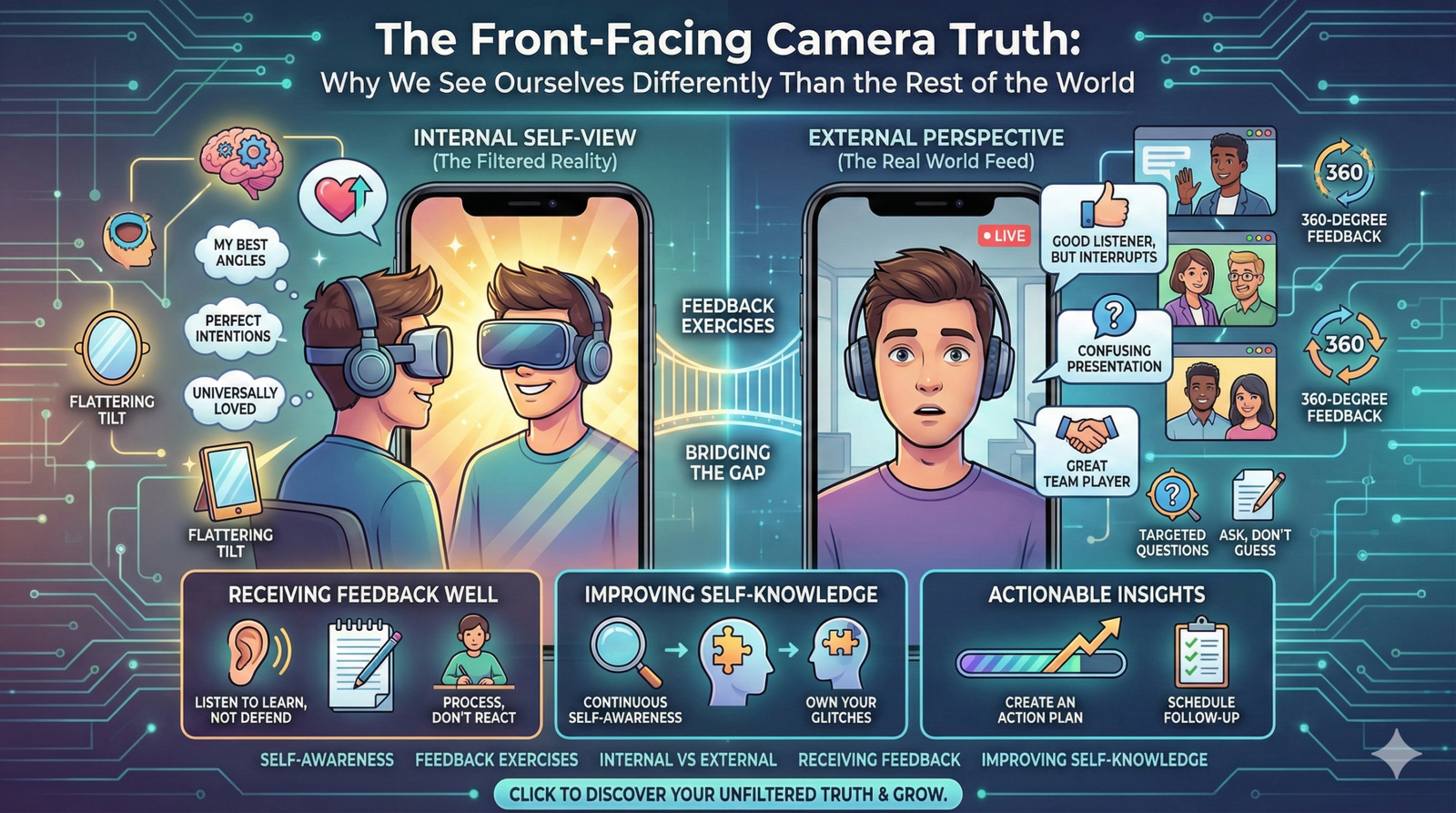
Have you ever accidentally opened the front-facing camera on your phone while looking down at your lap, only to be greeted by a creature that looks like a thumb with a wig on? It is a truly humbling experience, because in your mind, you were probably looking like a polished professional or a relaxed traveler, but that glitchy little lens tells a very different story. We all have a version of ourselves that lives inside our heads, a sort of internal PR department that smooths out the edges and adds a flattering filter to everything we do. But then there is the “raw footage” that the rest of the world sees, and the gap between those two things can be wider than the line at the DMV on a Monday morning. This gap is what we call a lack of self-awareness, and while it might sound like a fancy psychology term, it really just means we are walking around with a spinach leaf in our teeth and no one has told us yet.
Understanding how we are perceived is like trying to read the label on a jar from the inside, it is almost impossible to do without some help from the people standing on the outside. We often think we are being clear, kind, or hilarious, but our friends and coworkers might be seeing something totally different, like a “high-definition filter” that we have accidentally applied to our own personalities. This is not because we are bad people or because we are lying to ourselves on purpose, but because our brains are designed to protect us. If we saw every one of our flaws in 4K resolution every single day, we would probably never leave the house. So, we develop this “man in the mirror” problem where we only see what we want to see, and we ignore the glitches that everyone else is noticing in real time.
The reality is that while about 95% of us think we are self-aware, the actual number is closer to 10 or 15%, which is a pretty staggering difference if you think about it. It is like a whole world full of people who think they are great singers because they sound amazing in the shower, but the neighbors are currently calling the police because they think a cat is in distress. This is the core message of Tasha Eurich’s research, where she explains that introspection alone, just thinking about ourselves, isn’t enough to actually understand who we are. You can’t just stare at your own reflection and expect to see the truth, because the mirror you are using is tilted at a very flattering angle. To get the full picture, you have to be willing to look at the “front-facing camera” version of yourself, the one that shows the double chins and the awkward angles, and that requires a level of honesty that most of us find a little bit terrifying.
Imagine you are at a big family dinner, and you are telling a story that you think is absolutely riveting, but you notice your nephew is scrolling through TikTok and your sister is staring blankly at her mashed potatoes. In your head, you are the life of the party, but in reality, you might be the person who has been talking about air fryer settings for twenty minutes straight. When I was younger, I used to think that everyone enjoyed my company and that I was basically the human equivalent of a golden retriever, just universally loved. But as you get older, you start to realize that you are not everyone’s cup of tea, and for many people, that realization can be devastating. It certainly was for me at first, because I wanted to be the flavor that everyone liked, like vanilla or a really good sourdough.
Eventually, I learned that being “not everyone’s cup of tea” is actually a huge relief, because it means you can stop performing for people who were never going to like the show anyway. It is much better to appreciate the ones who actually want to be in the room with you and not worry about the ones who are looking for the exit. Some people might come around later, and some might not, but your job isn’t to be a people-pleasing chameleon. Your job is to understand your own “glitches” so you can at least be an authentic version of yourself, even if that version has a few bugs in the system. Why do we spend 90% of our energy trying to impress the 10% of people who don’t even like us? It is like trying to install a high-end gaming app on an old flip phone, it’s just not going to work, and you’re going to end up with a very hot battery and a lot of frustration.
If we want to close the gap between how we see ourselves and how others see us, we have to start treating feedback like a software update. Most of us hate software updates because they take forever, they change where the buttons are, and they always seem to happen when we are in the middle of something important. But without them, the whole system eventually crashes. Feedback is exactly the same way, it is the only way to fix the bugs we didn’t know we had. In the book Thanks for the Feedback, the authors point out that learning to receive feedback is actually more important than being good at giving it. We usually get defensive when someone tells us something we don’t like, our internal security system kicks in and we start making excuses, but that is like yelling at the GPS because it told you that you took a wrong turn. The GPS isn’t trying to hurt your feelings, it’s just trying to get you back on the right road.
One of the best ways to get this “GPS recalibration” is through something called a 360-degree feedback process. This sounds like a corporate buzzword that belongs in a boring office meeting, but it is actually a very cool way to see yourself from all angles. You basically gather input from your friends, your family, and your coworkers, and you compare their notes to your own self-evaluation. It is like looking at a 3D model of yourself instead of just a flat photo. When you do this, you want to ask specific, bite-sized questions instead of big, scary ones. If you ask someone “How am I doing?”, they will probably just say “Fine” because they don’t want to hurt your feelings or start a drama. But if you ask “What is one thing I could do differently that would make working with me easier?”, you are giving them permission to be honest without being mean.
You can also try the “Dinner Party Question” exercise, which is a great way to use your imagination to find your blind spots. Imagine you are at a dinner party with all your friends, but you have stepped out of the room for a minute to get more napkins. What would they say about you while you’re gone? Not the mean stuff, but the honest stuff, like “He’s great, but he always interrupts when he gets excited” or “She’s so helpful, but she never lets anyone else finish a sentence.” Once you write down what you think they would say, go out and actually ask them. You might find out that your “glitches” aren’t nearly as bad as you thought, or you might find out that you’ve been “interrupting” your way through every conversation for the last decade. Either way, now you have the data you need to hit the “update” button.
Developing this kind of self-awareness isn’t a one-time thing, it is more like a lifestyle choice, like deciding to finally start using moisturizer or checking the oil in your car. According to the Harvard Business Review, being self-aware is essential if you want to be a good leader or just a functional human being in the workplace. It allows you to see how your moods and your actions affect the people around you, which is basically the secret sauce for having better relationships. When you know that you get “cranky” when you’re hungry or that you tend to get “bossy” when you’re stressed, you can warn people. It is like putting a “Work in Progress” sign on your forehead, it helps people understand that your glitches aren’t personal, they are just part of your current operating system.
As Brené Brown reminds us in The Gifts of Imperfection, we have to be willing to let go of the “perfect” version of ourselves to find the real one. We often carry around this image of who we “should” be, like a pristine white couch in a fancy furniture store that nobody is allowed to sit on. But life is messy, and we are all a little bit stained and a little bit lumpy, and that is perfectly okay. The goal of self-awareness isn’t to become a perfect, glitch-free robot, it is to become a person who knows their own quirks and isn’t afraid to own them. When you stop worrying so much about the gap between your self-perception and reality, you can finally start living in the real world, which is a much more interesting place to be anyway.
So, the next time you catch a glimpse of that “gremlin” in the front-facing camera, don’t just close the app in a panic. Take a second to look at it, laugh at the angle, and remember that everyone else sees you from that angle too sometimes, and they still like you. Taking the leap into self-awareness can be scary, because you might find things you don’t like, but it is also the only way to truly connect with other people. When you know who you are, glitches and all, you stop guessing how people see you and you start just being there with them. It is a long game, and you will probably never be 100% self-aware, none of us are, but even a little bit of clarity can change everything. Eventually, you might even start to like the “unfiltered” version of yourself just as much as the one with the perfect lighting.
I would love to hear about your own “front-facing camera” moments or times when you realized your self-perception was a little bit off, so please share your thoughts and tag @iamcezarmoreno on social media! If you want more stories about navigating life and tech without the jargon, come join the conversation and subscribe to the newsletter at https://cezarmoreno.com. Let’s keep working on our software updates together.