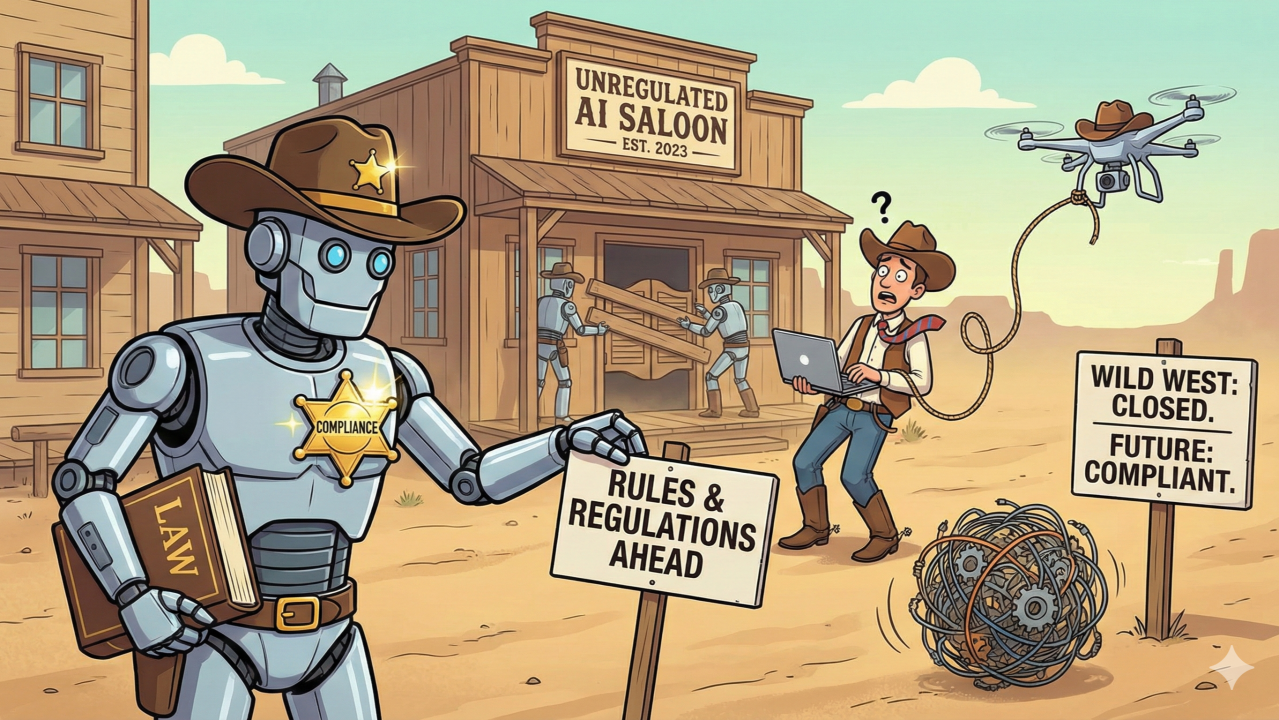
Imagine walking into a dusty town where there are no stars on any chests and the only rule is that there are no rules. You have people riding horses through the middle of the saloon, someone is trying to sell you a map to a gold mine that does not exist, and every time you turn a corner, someone is shouting at you to buy a bottle of magic hair growth tonic. This sounds like a scene from an old movie, yet it is exactly how the world of artificial intelligence has felt for the last couple of years. Your company leaders probably acted like the pioneers of old, racing across the plains to claim as much land as possible before anyone else could get there. They told you to move fast and they told you to use these new AI tools for everything from writing emails to making phone calls. They did not give you a map, they did not give you a handbook on how to treat the neighbors, and they certainly did not check to see if what you were doing was actually allowed. You were just told to find the gold and bring it back to the office as quickly as you could. Now, the dust is starting to settle and you are realizing that the gold is getting harder to find. Your lead generation is drying up like a creek in a heatwave, and your cold calling efforts are being met with locked doors and angry faces. The truth is that the law has finally arrived in this wild territory, and if you do not start pinning on a badge and following the rules, you are going to find yourself in a lot of trouble.
Compliance is not just a boring word for lawyers, it is the fence that keeps your cattle from wandering off and getting lost. For a long time, businesses treated AI like a secret weapon that let them bypass all the normal ways of doing things. You could use a computer to copy a human voice and have it call thousands of people in a single afternoon without ever stopping to ask if those people wanted to hear from you. It felt like a shortcut to success, but shortcuts in the Wild West often lead to a dead end. People are getting very tired of the noise and the tricks, and the government has finally decided to step in and act as the Sheriff. If you are still running your company like it is the first day of the gold rush, you are going to be very surprised when the bill for all those shortcuts arrives. The reason your leads are not working anymore is that your potential customers have built bigger walls to keep the outlaws away. They are using call blockers, they are ignoring emails from people they do not know, and they are reporting anything that sounds like a robot to the authorities. You cannot win a shootout if the other side has already left the building and locked the gate behind them.
The pioneers who survived the longest were not the ones who shot the fastest, they were the ones who built a town that people actually wanted to live in. To do that today, you have to understand the new laws of the land, starting with the Federal Communications Commission. The FCC is like the high court of the frontier, and they recently made a very big announcement about AI voices. They decided that when an AI speaks on the phone, it counts as an artificial voice, which means it falls under a set of rules called the Telephone Consumer Protection Act. For a long time, people thought they could get around this law because the technology was so new that the old books did not mention it by name. But the Sheriff has caught up, and now every time you use an AI voice to call someone without their written permission, you are breaking a very serious rule. This is not just a small mistake, it is a penalty that can cost you thousands of dollars for every single phone call. If your team is making five hundred calls a day, you do not need a math degree to see how quickly that could bankrupt even a very successful business.
You also have to worry about the laws coming from across the big ocean because they tend to influence what happens here at home. The GDPR is a set of rules from Europe that is very strict about how you handle people’s names, phone numbers, and secrets. Even if you are sitting in an office in the middle of Texas, if you are using AI to talk to someone in London, you have to follow their rules or face some very big fines. Europe also just created the AI Act, which is the first major rulebook specifically for artificial intelligence. It divides AI into different groups based on how much of a mess they could make. If your AI is being used to help people, that is fine, but if it is being used to trick them or take their data without asking, it is considered high risk. You can think of this like a rancher who has to prove his brand is legitimate before he can sell his cows at the market. If you cannot prove that your AI is being honest and safe, you might find that no one wants to buy what you are selling anymore.
One of the biggest problems we see today is that leadership teams have completely forgotten about training the posse. They bought the fancy new technology and gave it to the sales team, but they never sat everyone down to explain how to use it without getting into a fight. Your team probably thinks they are doing a great job because they are making more calls than ever before, but they do not realize they are burning bridges with every dial. You need to teach your team that transparency is their best friend on the trail. If you are using an AI to help with customer service, tell the customer right away that they are talking to a very smart assistant. People actually appreciate the honesty because it makes them feel like you are not trying to pull a fast one on them. When you try to hide the fact that a machine is talking, you are like a gambler with a card up his sleeve, and no one likes a cheater. By being upfront, you build a relationship that can actually lead to a sale instead of a hang up.
The next thing you need to focus on is the concept of consent, which is just a fancy way of saying you have to ask for permission before you walk onto someone’s property. In the early days of AI, companies would just scrape phone numbers off the internet and start calling, which is like walking into someone’s house while they are eating dinner. Today, you need to have a very clear way for people to say yes to being called by your AI. This should be a simple checkbox on your website that a child could understand. You should not hide it in a bunch of legal talk that is five miles long and written in tiny print. Just be honest and tell them that you would like to use an automated system to give them a call and help them out. If they check the box, you are allowed to cross the fence. If they do not check it, you need to stay on your side of the line. This might mean you have fewer people to call, but the people you do call will actually be happy to hear from you. It is much better to have ten conversations with people who want to talk than a thousand conversations with people who want to call the police on you.
You also need to take a very close look at the tools you are using and the companies that sold them to you. Many of these software companies were started by people who wanted to strike it rich in the AI gold rush, and they did not always think about the long term consequences. They might have told your boss that their tool is perfectly legal, but you have to remember that they are not the ones who will be standing in front of a judge if things go wrong. You should be asking these providers very specific questions about how they handle privacy and how they stay updated with the latest rulings from the government. If they cannot give you a straight answer, it is time to find a new partner who takes the law as seriously as you do. You would not buy a horse from someone who refuses to tell you where it came from, so do not buy AI software from someone who hides how it works.
Another major risk on the horizon is the rise of voice cloning and deepfakes, which are the equivalent of a masked rider in the middle of the night. This technology allows a computer to sound exactly like a specific person, which can be very dangerous if it is used to trick people. The government is already working on ways to label these voices so that everyone knows they are not real. Even if you are using it for something good, like making a personalized message from your company’s founder, you need to be very careful about having all the right permissions in place. You should never use someone’s voice without a written agreement, even if they work for you. In the future, every AI voice will likely have a digital watermark that tells the world exactly who created it. If your company is not ready for that level of accountability, you are going to find yourself on the wrong side of history.
What should you do this afternoon to start bringing some order to your territory? The first step is to do a full audit of every way your company uses AI to talk to the public. Look at your scripts, look at your automated emails, and look at your phone systems. If you find anything that is designed to trick people or that does not mention that an AI is being used, you need to change it right now. The second step is to check your lists and make sure every single person on them has actually given you permission to contact them. If you bought a list from a shady source, throw it away and start fresh. It might feel like a waste of money, but it is nothing compared to the cost of a lawsuit. Third, create a simple set of guidelines for your team so they know exactly what the boundaries are. Give them a clear path to follow so they can do their jobs without worrying about breaking the law.
Compliance is not just about avoiding trouble, it is about building a business that can actually grow over time. When you follow the rules, you are telling the world that you are a professional organization that values its customers. This creates a level of trust that your competitors who are still acting like outlaws will never have. Think about the most successful businesses in history, they are the ones that built a solid foundation and followed the laws of the land. They did not rely on tricks or shortcuts to get ahead. By being the most compliant company in your field, you are setting yourself up to be the leader that everyone else looks up to. People will want to do business with you because they know you are honest and that you respect their time. In a world where everyone is being bombarded by robots and scams, being the one honest voice in the room is a massive advantage.
You have to remember that the leaders who pushed you to move fast are often the first ones to complain when things stop working. They might not understand why the leads have dried up or why the phone is not ringing like it used to. It is your job to be the voice of reason and explain that the game has changed. You can tell them that the Wild West is over and the Sheriff has arrived, and if we want to keep making money, we have to start doing things the right way. It might mean a bit more work in the short term, and it might mean your growth slows down for a minute while you fix the leaks, but it is the only way to ensure that you are still around in five years. A business built on non-compliant AI is like a town built on sand, it might look great for a while, but the first storm will wash it all away.
Teaching your team about these rules should not be a one time event, it should be a regular part of how you operate. Just like a rancher checks his fences every season, you should be checking your AI systems to make sure they are still following the latest laws. New rulings come out all the time as the technology gets better and the government learns more about how it works. You need to stay informed and keep your posse updated so they don’t accidentally wander off the trail. This can be as simple as a ten minute meeting once a month to talk about any new rules or to review how the current systems are performing. When everyone is on the same page, the whole team can move forward with confidence.
One of the most important things to look out for is how your AI handles data once it has been collected. In the Wild West, people didn’t really think about where their water came from as long as it was wet. Today, we know that if the well is poisoned, the whole town gets sick. Your data is the water that keeps your AI running, and if that data is stolen or used improperly, your entire system becomes toxic. You need to make sure that the names and numbers you collect are stored in a safe place where outlaws cannot get to them. You also need to have a clear process for when someone asks to be forgotten. If a customer tells you they don’t want to be in your system anymore, you need to have a way to erase them completely and quickly. This is not just a polite thing to do, it is a legal requirement in many places.
The future of AI is still very bright, but the way we use it is going to have to change. We are moving away from the era of big, loud, automated campaigns that treat people like numbers on a spreadsheet. We are moving toward a world where AI is used to create real value and to help people solve their problems in a more efficient way. Imagine an AI that knows exactly when a customer needs help and reaches out with a solution that actually works, instead of an AI that just calls them during dinner to offer a credit card they don’t want. When you use AI in a compliant and respectful way, it becomes a powerful tool for good. It allows you to grow your business while also making the world a little bit better for everyone who interacts with you.
As you look at your company this week, try to see it through the eyes of a customer who is tired of being hounded by machines. Look at your processes and ask yourself if you are being the honest town leader or the shady salesman in the back of the saloon. It is never too late to change your ways and start building something that lasts. Grab the rulebook, talk to your team, and start making the changes that will save your business from the coming storm. The Wild West was a fun ride while it lasted, but the future belongs to those who know how to live by the law. You have the power to turn your company into a shining example of what modern, compliant AI looks like, and the rewards for doing so will be much bigger than any gold mine.
I would love to hear your thoughts on how your company is handling the end of the AI Wild West. Have you had to have some tough conversations with your leadership about slowing down to get things right? Have you found any tools that make staying compliant a lot easier for your team? Please share your stories and your advice with me in the comments, so we can all learn from each other. If you enjoyed this guide and want to see more content that makes complicated technology easy to understand, please make sure to follow me at https://cezarmoreno.com to get the latest tips on AI, business, and staying ahead of the curve delivered right to your inbox. Let’s work together to build a future where technology and honesty go hand in hand.