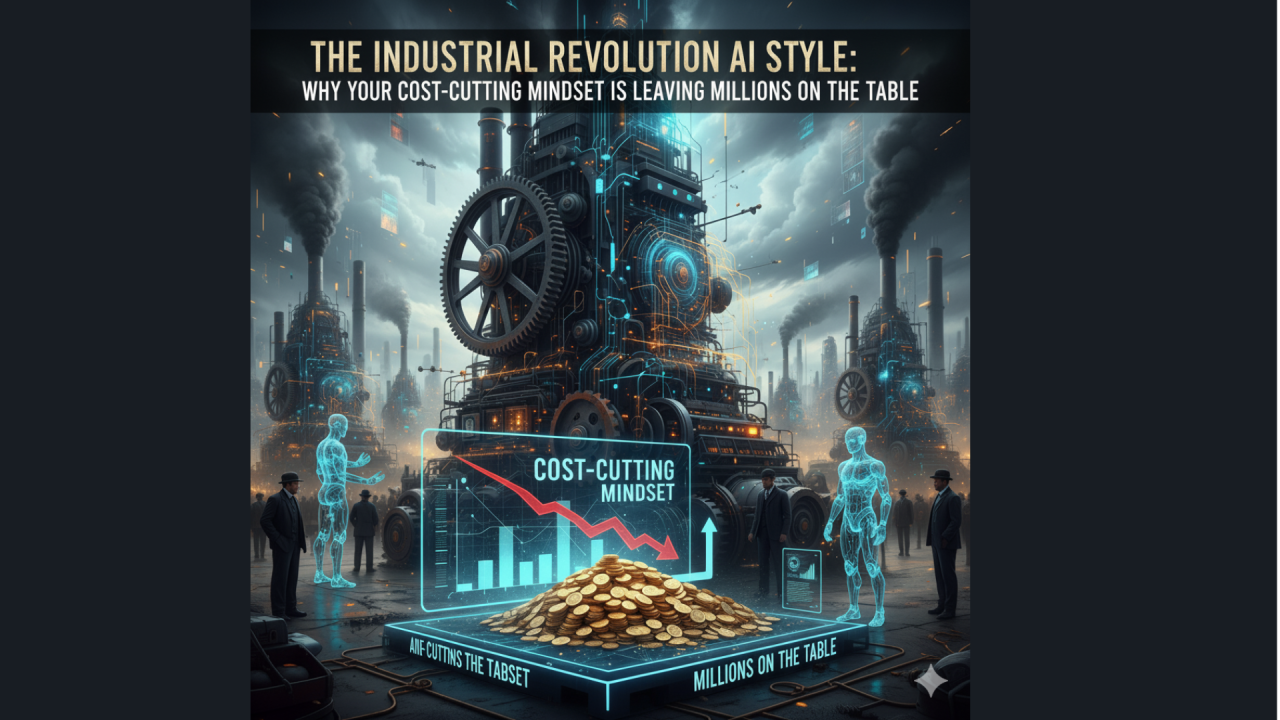
It’s amazing how many smart, dedicated executives and business owners have a collective blind spot when it comes to the biggest technology shift of our time, I’ve seen it firsthand, and frankly, it’s baffling. I spend my days working with brilliant companies, helping them automate their most tedious tasks, migrate their operations to faster, smarter systems, and implement bulletproof policies for this new age of artificial intelligence. We check the boxes, we clean up the process, and we save a bundle, everyone is happy to trim the fat, nobody likes wasted money, and AI is fantastic at finding those tiny, forgotten leaks in the budget. This is all good work, the kind of professional, responsible stuff that makes quarterly reports look shiny, but then I ask the question, and the whole room goes silent, a collective, blank stare washes over the C-suite.
The question is simple, but its power is profound, “How does AI bring you revenue?”
The typical executive response is to repeat the cost-saving mantra, they’ll talk about cutting staff hours, reducing errors, or lowering server costs, save, save, save is the tune they’re all singing, and while that’s a decent opening verse, it’s a terrible chorus. It’s like owning a Ferrari and only using it to drive to the local gas station to check the tire pressure, sure, you’ve been efficient with that one task, but you’re missing the entire point of the machine. The attitude is understandable, seeing AI as a powerful pair of scissors for trimming expenses is the low-hanging fruit of adoption, it’s the easiest sell to the board and the simplest implementation, but focusing solely on expense reduction is a strategy with a hard, frustrating ceiling. You can only cut so much before you hit bone, before you start harming the very processes that keep your company running, but revenue, the beautiful, exhilarating concept of earning, has no ceiling at all, it’s a wide-open sky of possibility.
This my friends, is where the professional pivot has to happen, a mental shift that moves us from merely surviving in the new economy to truly conquering it, from hoping for a modest budget surplus to generating astronomical growth that no manual effort could ever match. The problem isn’t a lack of tools, it’s a lack of imagination, a failure to ask the right, aggressive question about tomorrow’s bottom line, instead of worrying about yesterday’s overhead. We’ve become so obsessed with the mechanics of the machine, the automation, the migration, the policy documents, that we’ve forgotten to look at the massive new world it can build for us, the world of income.
This isn’t just some theoretical business school lecture, this is a real, measurable phenomenon happening right now across industries, and the divide between the companies that get it and those that are stuck in the “save” loop is widening every single day. The “save, save, save” mentality is safe, I grant you that, it minimizes risk, it delivers predictable small victories, but predictable small victories don’t change the trajectory of a company, they don’t capture new markets, and they certainly don’t excite investors the way a bold, revenue-generating strategy does. I’ve been in those boardrooms where the cost-cutting reports are celebrated with cautious enthusiasm, and then the conversation stalls because nobody has a clue how to leverage that saved time or money into a new income stream. It’s like meticulously sweeping up the sawdust from the factory floor without ever looking up to see the perfectly crafted, highly valuable product that wood created, the one that people are queuing up to pay a premium for. The purpose of cleaning the floor isn’t the clean floor itself, it’s maximizing the output of the profitable work, and AI is the ultimate tool for that maximization.
We are at a critical moment, one that parallels a seismic historical shift, so let’s take a field trip back to 18th-century England, the dawn of the Industrial Revolution. Imagine you’re a textile factory owner, and suddenly, you have a new machine, the spinning jenny, or maybe the power loom, these inventions are revolutionary, they’re fast, consistent, and they do the work of ten people with fewer mistakes. In the early days, the owners of these machines saw them the same way modern executives see AI, as a magnificent cost-cutter. The primary win was lowering the cost of production and reducing the need for expensive, skilled human labor, they saved on wages, they saved on time, they saved on material waste, and everyone patted themselves on the back for their brilliant efficiency. They were doing good business, responsible business, but they were still thinking small, limiting the incredible power of the steam engine to merely improving the speed of their old cart, not realizing it could power an entire new mode of transportation.
But then, the truly visionary entrepreneurs realized the power of the machine wasn’t just in how much money it saved them on making the old product, it was in the fact that it could make an entirely new world of products. The capability to produce vast quantities of cloth cheaply didn’t just save money on existing cloth, it created mass-market clothing, it made things accessible to millions, it spurred global trade, it created entire new transportation and distribution networks, and it birthed the modern economy. The invention was not just a cost-cutting tool, it was the engine of explosive revenue generation and the beginning of new industries that had never existed before, the companies that embraced the new capacity to create, not just cut, became the new titans of industry, the ones who didn’t are history. If you only used your steam engine to power a fan in your office, you’re missing the chance to build a railway line that crisscrosses the continent. That’s where we are with AI right now, the time for tinkering with the fan is over, it’s time to start laying tracks. The fundamental mindset challenge we must conquer is the ingrained difference between saving a dollar and earning a dollar. Saving is passive, it’s defensive, and it requires less imagination, earning is active, aggressive, and demands innovation. Cost-cutting is a defensive football strategy, necessary to protect your assets, but revenue generation is a dynamic, high-scoring offense, and the only way to win the game is to get the ball into the endzone. For all the complexity of AI, the ultimate purpose should not be to automate your current business, but to elevate your future business. We’ve built the foundation of automation, migration, and policy, that’s great, it’s the plumbing and electricity, but a company isn’t judged by the neatness of its basement, it’s judged by the skyscrapers it builds above ground, the ones that produce an income stream. It’s about shifting the technological investment from merely a necessary expense to a strategic asset that has its own measurable, positive P&L statement.
So, how do we make the leap from AI as a pair of scissors to AI as a cash register? The path involves shifting the technology from the back office, where it handles paperwork, to the front lines of the business, where it interacts with customers, develops products, and finds new markets. This pivot rests on three robust pillars of income generation that any business, regardless of size or industry, can implement today, you just need the vision to see past the ledger. You need to look at your data not as a storage problem, but as a potential product, and look at your AI systems not as a substitute for human labor, but as a powerful, tireless engine for discovering new wealth.
Pillar 1: The Ultimate Sales Closer, Qualifying Leads The modern sales team is often spending a shocking amount of time talking to people who were never going to buy, it’s a marathon of polite conversation with a predictable dead end, and every minute your sales rockstars spend on a low-quality lead is a minute of revenue lost. This isn’t just a waste of time, it’s a direct, quantifiable drag on your potential income, and it’s a problem AI was practically designed to solve. When I talk to executives about their sales cycle, the waste is always staggering, and they nod along, accepting it as a necessary evil, but I’m here to tell you that it’s not just unnecessary, it’s actively eroding your revenue potential.
Imagine your leads arriving as a huge, messy pile of data, a mountain of website clicks, half-filled forms, past purchase history, and even social media chatter. A human can maybe look at a dozen data points to decide if a prospect is “hot,” but an AI system can analyze literally thousands of data points faster than you can blink, it doesn’t just score a lead based on job title, it scores them based on the intent hidden in the data. The system can look at a prospect who visited a specific pricing page twice, downloaded a detailed white paper, and opened three of your last five emails, and it can declare with high certainty that this person is not just kicking tires, they are actively considering a purchase. Think of all the subtle, behavioral clues that humans miss, the pauses, the second visits, the sequence of clicks, AI turns all that noise into a crystal clear signal that shouts, “Buy me now!”
This means your human sales professional, the one who is brilliant at building relationships and closing deals, now spends their entire day talking to people who are already standing at the cash register with their wallets out. The AI acts as the world’s most diligent bouncer, politely but firmly moving aside the tire-kickers so that your best people can focus solely on the high-value conversations that directly lead to signed contracts and fatter bottom lines. It’s a complete re-engineering of the sales process, shifting from a wide net approach that costs time and energy to a laser-focused sniper shot that delivers pure revenue lift. You’re not just saving time by automating data entry, you’re maximizing your human capital on the singular activity that generates income, closing the deal, and that, my friends, is a direct line to new revenue that has nothing to do with saving on paperclips.
Pillar 2: Making the Good Stuff Better, Improvements to Existing Products and Services Think about your current product or service, it’s good, maybe even great, but it’s probably full of little annoyances, the paper cuts of your user experience. These tiny flaws lead to customer churn, negative reviews, and a ceiling on what people are willing to pay for it, and the problem is, this feedback is scattered everywhere, buried in thousands of support tickets, mumbled in forgotten call recordings, and hidden in the endless scroll of social media comments. No human team, not even your smartest product managers, can manually process that firehose of data and extract truly actionable insights. They get overwhelmed, they prioritize the loudest customer, and the underlying, systemic flaw that’s costing you millions in lost upgrades and churn goes unaddressed.
This is where AI becomes your hyper-intelligent Chief Product Officer. It doesn’t just read the support tickets, it analyzes the tone and frequency of the complaints to find the single, most frustrating bottleneck that, if fixed, would make your product indispensable. For a software company, the AI might find that 40% of their “cancel” reasons are tied to a single, confusing menu option, fix the menu, and the cancellation rate drops, revenue saved, revenue earned. But let’s go further, for a service company, the AI might realize that customers consistently ask for one specific, niche add-on that your company doesn’t offer, you develop that add-on, package it as a premium tier, and suddenly you have a new, high-margin revenue stream from existing happy customers. AI doesn’t just identify a problem to fix, it identifies an opportunity to monetize, a gap in the market that your current customers are begging you to fill.
The AI is essentially running a million-person focus group that works 24/7 and doesn’t need to be fed donuts, it identifies where customers are happy to pay more for a better experience or where a simple fix will stop them from leaving. It shifts the product development process from guessing games and internal debates to a data-driven science, resulting in a Version 2.0 or an “Executive Service Tier” that is perfectly tailored to what the market is willing to open its wallet for. Your existing offerings become premium, stickier, and more profitable, because you’re using AI to design the features and pricing that your most valuable customers want, not what your internal team thinks they want. This proactive improvement turns product development from a cost center into a continuous revenue engine.
Pillar 3: The Untapped Gold Mine, Tapping into New Businesses This is the big one, the true Industrial Revolution moment, this is where we stop thinking about improving the old factory and start thinking about building a brand new one. The most valuable asset your business owns is not the product it sells today, it’s the massive amount of proprietary data it generates every single day, and AI is the key that unlocks that asset. When I see the blank stare in the executive suite, I know it’s because they only see the data as a liability to be stored securely, not as a potential asset to be sold for a profit. You must understand that the data you generate is a byproduct of your current business, and that byproduct could be the main product of your next business.
Consider a logistics company that has been using AI simply to optimize delivery routes and save on fuel costs, classic “cost-cutting.” The AI learns everything about traffic patterns, depot efficiency, vehicle maintenance, and driver performance. That system, which was built to save $50,000 in gas, has actually created a hyper-sophisticated model of supply chain dynamics that is incredibly valuable. They can pivot and start selling that route optimization AI as a standalone service to dozens of other industries, maybe municipal waste collection or utilities field maintenance. Suddenly, the thing that was an internal expense is now an entirely new, high-margin software business unit. The data, once a mere operational input, is now a valuable, scalable product. Another powerful example is a company that sells specialized industrial equipment. They use AI to monitor the equipment’s performance for preventative maintenance, saving customers money on breakdowns. The AI, however, discovers a correlation between a certain vibration pattern and an emerging industrial trend among their customer base, a pattern so subtle no human could have ever noticed it. The company can monetize this predictive insight, not by fixing the equipment, but by selling a market intelligence report to financial traders or industry analysts who pay a premium for that forward-looking knowledge. They have essentially created an AI-powered media or consulting firm based on the invisible data streams of their old business, a new income stream that is pure profit because the data collection was already paid for by the original cost-cutting project. This requires the greatest vision, but the reward is exponential growth, it’s the difference between being a good company and being a market pioneer. It’s about recognizing that the AI you built to make your own life easier could be the perfect product for someone else’s toughest problem.
The shift from AI cost-cutter to cash-creator is not an implementation challenge, it is a challenge of imagination. You have the most powerful analytical tool in human history at your disposal, and you must decide if you’re going to use it to save on office supplies or to fundamentally reimagine the way your company makes money. Stop asking, “How can AI make this existing process cheaper?” and start asking, “What entirely new revenue stream is our data quietly telling AI to create?” The future belongs to those who see AI not as a means to a cheaper existence, but as the blueprint for an infinitely richer one, and I’m here to tell you that the time for that pivot is now.
We’ve done the hard work of making the systems leaner and smarter, now let’s make them richer, that’s the professional, witty pivot that turns a simple efficiency project into a growth story, a story that deserves much more than a blank stare.
I want to know what hidden revenue streams your data might be pointing toward. What one existing process in your business do you think, if analyzed by AI, could be sold as a new product or service?
Share your thoughts, and be sure to tag @iamcezarmoreno on social media to keep the conversation going. To get more insights on how to make AI work for your bottom line, not just your overhead, follow, subscribe, or join the newsletter at https://cezarmoreno.com.